

ChatGPT for Financial Services was developed in partnership with investment bankers Morgan Stanley and Evercore. Customers can access key data sources without configuring connectors.
ChatGPT for Financial Services was developed in partnership with investment bankers Morgan Stanley and Evercore. Customers can access key data sources without configuring connectors.

Experts including forward-deployed engineers (FDEs) are deemed key factor in accelerating outcomes, reducing risk, and ensuring operational impact of AI.
CIO Kenny Mullican notes that vertical AI platforms from Google Cloud eliminate the need for building custom interfaces and make it easier to roll out industry-specific use cases.
New tools aimed at enforcing cost discipline include an AI pricing calculator, detection of spending anomalies, and spending caps for individual AI projects.

Law firms that collaborated in platform design highlight industry AI opportunities to eliminate manual work and drive innovation for better client service.
On the strength of customer design partnerships and an expansive ecosystem, Google Cloud delivers AI platforms that could unlock AI innovation in support of vertical use cases.

With backers including Anthropic, Google, Microsoft, and JPMorgan Chase, Akrites coordinates disclosure and remediation as discovery of open-source vulnerabilities in the AI era is outrunning defense.

Open Knowledge Format, or OKF, aims to become the MCP of representing knowledge and context so it can be consumed easily by AI agents without a translation layer.

Massive Google Cloud customer use cases and the emergence of patient agency supported by AI are early highlights of HIMSS 2026, according to healthcare tech exec Paul Swider.

Universal Commerce Protocol, or UCP, has the backing of major retailers including Walmart, and financial services giants including American Express and Visa. It aims to standardize transactions on an end-to-end basis.

A deep look at AI agent usage by Google Cloud reveals telecom and manufacturing firms setting the pace, while security and customer service use cases are benefiting a range of industries.

Even with $90 billion in Q2 CapEx spending, the major hyperscalers say cloud and AI demand will exceed supply until at least late 2025.
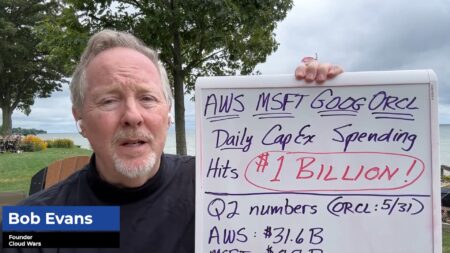
Cloud hyperscalers including AWS, Microsoft, Google and Oracle spent nearly $1 billion per day in Q2 2025 on AI infrastructure to meet unprecedented demand, signaling a long-term transformative shift toward AI-powered enterprise.

Oracle and Google Cloud have partnered to deliver Gemini AI models via OCI, accelerating enterprise adoption of generative AI with seamless access and flexible billing.

Analysts grilled Jassy on AWS’s relative underperformance — and the numbers don’t lie: rivals are catching up fast.

Despite strong revenue growth, AWS’s positioning in its latest earnings call drew scrutiny, especially when comparing its performance to Microsoft and other hyperscalers, whose cloud businesses are accelerating more rapidly.

Satya Nadella broke tradition in Microsoft’s Q4 call, directly comparing Microsoft’s AI and cloud capabilities to AWS, Google, and Oracle, citing unmatched scale, speed, and infrastructure capacity.

Satya Nadella touts Microsoft’s Q4 cloud dominance, declaring MSFT #1 and challenging Google, Oracle, and AWS to compete for second place.

AWS’s strong Q2 results falter when compared to the accelerated AI-driven growth of Microsoft, Google Cloud, and Oracle.

Microsoft, Google Cloud, and Oracle are accelerating cloud growth and capturing more AI-driven business, while AWS lags behind in both pace and market share gains.