

Meta’s massive Azure spending shows how AI is reshaping tech competition, with rivals increasingly becoming customers as infrastructure emerges as the new battleground.
Meta’s massive Azure spending shows how AI is reshaping tech competition, with rivals increasingly becoming customers as infrastructure emerges as the new battleground.

Microsoft, Salesforce, and UiPath are taking different approaches to free developer AI capacity as consumption emerges as an increasingly important metric for the enterprise technology industry.

AI monetization is moving upstream as rising agentic development costs push Microsoft and other vendors to charge builders for creating, testing, and executing AI-powered products.

After proving its custom silicon strategy with Maia 200, Microsoft is preparing a much larger Maia 300 push designed to support both AI training and inference.

Microsoft Research and Paige’s PRISM 2 combines nearly 2.5 million pathology images with clinical language, creating a versatile AI model for cancer detection, biomarker prediction, and research.
Microsoft CEO Satya Nadella has confirmed plans for a Copilot super app that will unite chat, coding, Cowork and autonomous AI agents, creating a single flagship experience spanning both Microsoft’s consumer and commercial AI offerings.

AI vendors are increasingly turning to forward deployment engineers as enterprises struggle to move AI pilots into production and consumption-based models grow.

Project Perception represents Microsoft’s push beyond reactive cybersecurity, coordinating red, blue, and green AI agents in a closed-loop system designed to continuously identify vulnerabilities, assess risks, implement fixes, and strengthen enterprise defenses.

AI agents are beginning to outpace Copilot licenses, signaling that organizations are creating increasingly valuable custom automation across the Microsoft ecosystem.

Nadella believes enterprises should have the freedom to choose AI providers, privately train models, manage costs, and retain complete control over their accumulated organizational intelligence.

Businesses can unlock greater AI value by understanding when to use chat assistants, coding agents, co-work agents, or custom workflows.

Microsoft says AI sovereignty is about maintaining national control while embracing the world’s best AI technologies, rather than isolating countries from global innovation.

Microsoft’s latest education findings reveal that AI access is no longer the hurdle—effective implementation and structured training are.

The AI Deployment Wars are expanding beyond technology into branding. Microsoft’s ambitious Frontier Company contrasts sharply with AWS’s practical Forward Deployed Engineering, raising questions about which message resonates with enterprise executives.
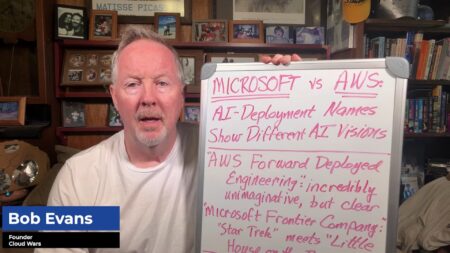
Welcome to the Cloud Wars Agent and Copilot Minute — your daily cloud news and commentary show. Each episode provides…

The new AI Deployment Wars reveal that enterprise customers need more than technology: they need strategy, process modernization, secure integration, and change management.
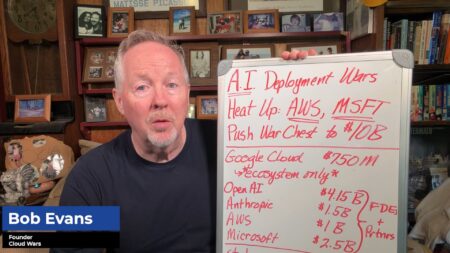
The world’s leading AI companies are investing nearly $10 billion to ensure AI deployments generate measurable business outcomes rather than simply impressive technology.

Microsoft is accelerating its Frontier Firm vision with a new business unit that embeds 6,000 AI and industry experts directly with customers to build, optimize, and scale enterprise AI systems.

Microsoft’s new Frontier Company represents the company’s biggest step yet toward making its frontier firm vision a reality for enterprise customers.
Microsoft is shifting Copilot Cowork to usage-based pricing while exploring lower-cost AI models, signaling a strategy focused on performance, economics, and customer choice.