

One of the top areas of focus at the recent Microsoft Ignite conference was Agent 365, which the company has positioned as a “control plane” for AI agents and which Agent and Copilot Analyst Ronak Mathur, a Microsoft and AI expert working in the healthcare field, has dubbed Microsoft’s “HR for AI agents.”
Both of those descriptions – which are complementary and not contradictory – materialized in considerably more detail this week at an online event held by Microsoft to give customers and partners a more in-depth view of Agent 365 and the functions it performs.
Throughout these demos, Microsoft executives reinforced two key points:
- Much or all of the functionality exists in other places and can be accessed through other Microsoft platforms, but Agent 365 brings it together in one dashboard for benefit stakeholders that need a comprehensive view into their AI estate. As noted by Shilpi Sinha, Partner Director, Agent 365, customers want to know “How we manage this agent sprawl and keep our organizations secure while effectively managing all of them…and not have to rebuild your entire IT infrastructure or practices.”
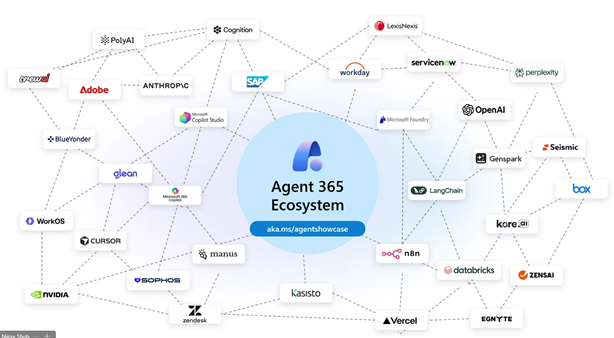
- The management and governance enabled by Agent 365 applies to agents built within Microsoft tools and those that customers build in house, as well as agents they build on an expanding range of third-party platforms (see ecosystem graphic below; the company notes that its roster of Agent 365 partners is growing quickly).
Agent 365 In Action
To recap briefly, Microsoft noted from the time that Agent 365 was first outlined at Ignite that it supported five primary functions: an agent registry, access control, visualization, interoperability, and security.
The demo and narrative, provided by Microsoft’s Shilpi Sinha, Partner Director, Agent 365, filled out details in several of those categories.
Sinha presented the Agent 365 overview dashboard, where all critical metrics are available in a single view. These include user licenses, total agents in use by publishers, as well as copilot usage and non-usage among those with licenses. Users can see the most popular agents by usage levels and their business impact in terms of time saved by agents.
The dashboard provides top actions available for an individual to take, such as responding to user requests to start utilizing a particular agent or isolating security risks that have been detected. “You can take control even on the number of agents that are missing an owner,” Shilpa said. “I can go ahead and assign a new owner or select a user from my organization.”
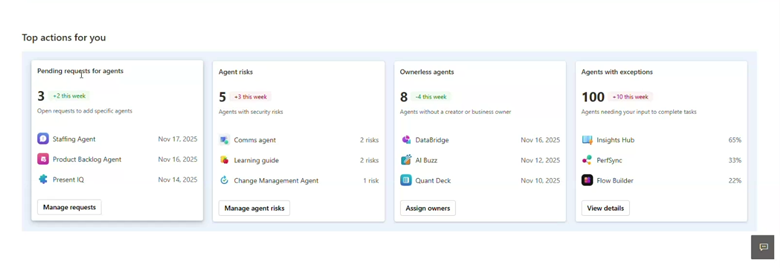
She added, “This is one of the biggest things that enables you to avoid agent sprawl; you want to make sure people are always associated with an agent so you know who’s responsible and who’s acting on it.”
A manager can drill in to gain considerably more detail on any given agent, with insights including connected data and tools to which it has access, security and compliance controls that are in place, permissions, and total active users for that particular agent.
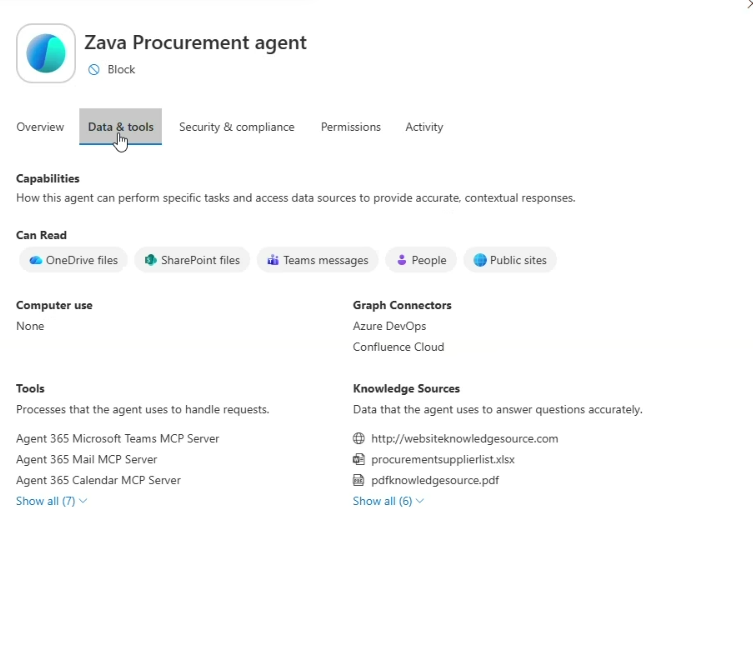
This agent-specific view can be used to analyze the risks with any given agent as flagged by the system, such as abnormal sign-in frequency, or use by individuals who may pose security risks:

An “Apply Policy” template feature lets users apply policies and permissions to groups of agents when and where applicable, rather than on an agent-by-agent basis.
Another view provided by Agent 365 is a visual representation of the agents in an organization, which can be analyzed in various forms; options include a simple list that can be displayed or exported, as well as a graphical format that illustrates agents clustered by the platform they’re built on.
Attendee polling at the event indicated customers are in the earliest days of evaluating Agent 365 technology, but the insights shared should advance their understanding of what’s possible with this platform, the value of integrating otherwise dispersed functions, and how users can introduce a unified approach to management and governance as their AI agent rollouts continue.
More Microsoft AI and Security Insights:

AI Agent & Copilot Summit is an AI-first event to define opportunities, impact, and outcomes with Microsoft Copilot and agents. Building on its 2025 success, the 2026 event takes place March 17-19 in San Diego. Get more details.

Tom Smith
Analyst
Cloud Wars, Agent and Copilot

Related Posts