

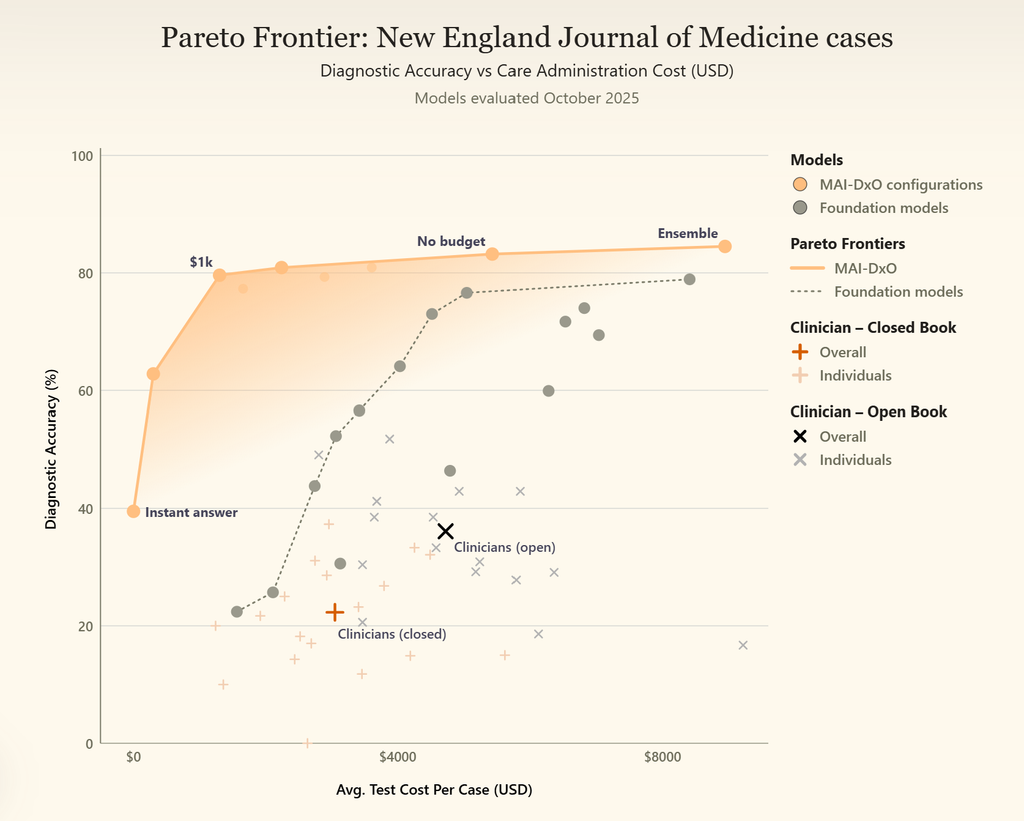
Microsoft has been full steam ahead with its work to turn AI into the next generation of healthcare products, developing an AI diagnostic system called MAI-DxO (Microsoft AI Diagnostic Orchestrator) that, according to testing, achieves 83.2% diagnostic accuracy in complex medical cases, compared with 36.1% for generalist physicians using reference materials. That’s right, more than twice the diagnostic accuracy.
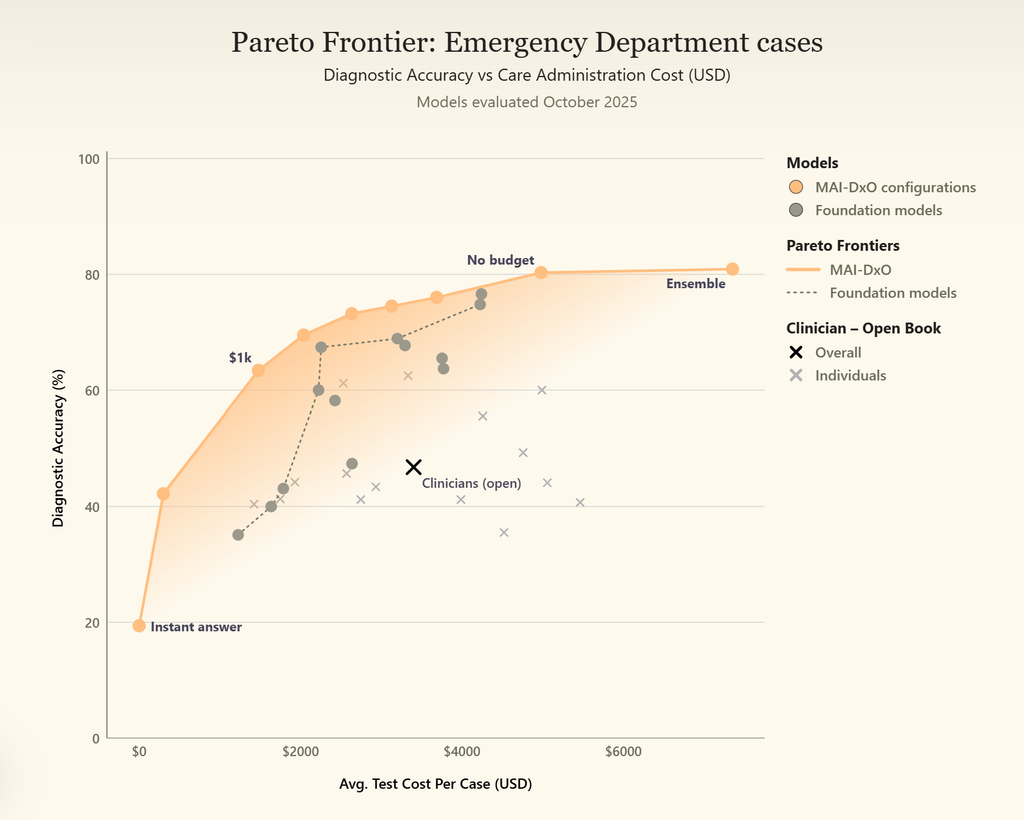
When reference tools were taken away, doctors achieved just 22.3% accuracy. When the tool was tested in emergency department cases, it achieved 80.3% accuracy, compared with 46.8% for physicians. Regarding how this testing was carried out, Microsoft tested the system against 304 complex cases from The New England Journal of Medicine, as well as a separate dataset of historical emergency department cases.
So, how does it work, and what’s driving these incredible results?
How Does MAI-DxO Work?
Interestingly, MAI-DxO takes a panel-style approach, meaning it simulates the process of asking multiple medical specialists for their opinions. So, instead of immediately delivering a diagnosis, the tool asks follow-up questions, requests tests, and evaluates new evidence as the diagnosis progresses.
The original research used OpenAI’s o3 model, although Microsoft has since reported further testing with newer models, including GPT-5.5. Microsoft also created a benchmark called the Sequential Diagnosis Benchmark (SDBench) to assess diagnostic reasoning and decision-making.
Beyond this, the tool also considers the financial cost of investigations, which should, in theory, help reduce healthcare spending. So, as well as potentially improving diagnostic accuracy, it could also lower the cost of investigations.
Now, these results really are outstanding, but there are some other considerations to take on board. The test results are based on historical medical cases, not live patient consultations, so this means there isn’t yet proven evidence of better patient outcomes in real-world clinical settings.
On top of this, the comparisons were not pitted against medical teams, but individual physicians, which is particularly important given that the tool takes a panel-style approach. Essentially, more clinical trials and independent testing are needed before the tool is rolled out for widespread use. But, these initial results are certainly encouraging.
This research matters. Multi-agent AI systems could soon help doctors improve diagnostic accuracy, reduce unnecessary testing, and the associated healthcare costs. And, this has a direct impact on patients.
Instead of replacing doctors, using tools like MAI-DxO could help healthcare professionals make more informed and efficient decisions. While Microsoft’s AI research has taken a big step forward in the healthcare space, it isn’t alone.
Could Oracle Pose a Challenge to Microsoft?
Microsoft isn’t the only technology giant looking to transform healthcare with AI. If you’ve been following Bob Evans’s coverage of Oracle’s recent AI World conference, you’ll have seen that Oracle is also making significant moves in this space with its new Oracle Health Application Suite.
Unlike Microsoft’s MAI-DxO, which, as you’ve read, focuses specifically on improving complex medical diagnosis, Oracle is taking a much broader approach, embedding AI throughout the healthcare ecosystem.
This could make Oracle a significant competitor in the race to bring AI into everyday healthcare. While the two companies are taking different approaches, the end goal is the same: integration. It’s about embedding these tools into real-world medical environments and making them work within the complexity of healthcare workflows, structures, and systems. Once a company delivers a truly integrated solution, it’s unlikely to be replaced any time soon. The race is on!

Kieron Allen
Analyst
Cloud Wars, Agent and Copilot

Related Posts