

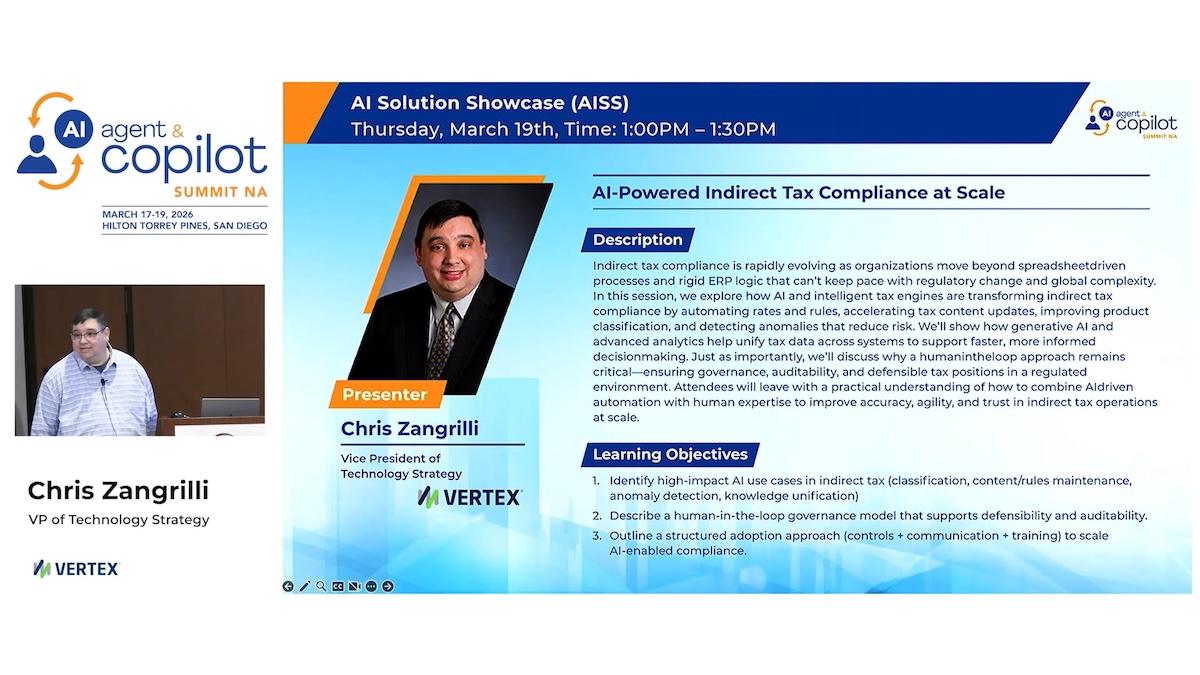
Indirect tax compliance is rapidly evolving as organizations move beyond spreadsheet‑driven processes and rigid ERP logic that can’t keep pace with regulatory change and global complexity.
In this session, we explore how AI and intelligent tax engines are transforming indirect tax compliance by automating rates and rules, accelerating tax content updates, improving product classification, and detecting anomalies that reduce risk. We’ll show how generative AI and advanced analytics help unify tax data across systems to support faster, more informed decision‑making. Just as importantly, we’ll discuss why a human‑in‑the‑loop approach remains critical—ensuring governance, auditability, and defensible tax positions in a regulated environment.
Attendees will leave with a practical understanding of how to combine AI‑driven automation with human expertise to improve accuracy, agility, and trust in indirect tax operations at scale.
- Learning Objective 1: Identify high-impact AI use cases in indirect tax (classification, content/rules maintenance, anomaly detection, knowledge unification)
- Learning Objective 2: Describe a human-in-the-loop governance model that supports defensibility and auditability.
- Learning Objective 3: Outline a structured adoption approach (controls + communication + training) to scale AI-enabled compliance.
Terms: All rights reserved by the speaker, AI Agent & Copilot Summit NA, and Dynamic Communities and cannot be reproduced or distributed without express written consent by the speaker and Dynamic Communities.
Speakers
Chris Zangrilli, Vice President of Technology Strategy, Vertex

Related Posts