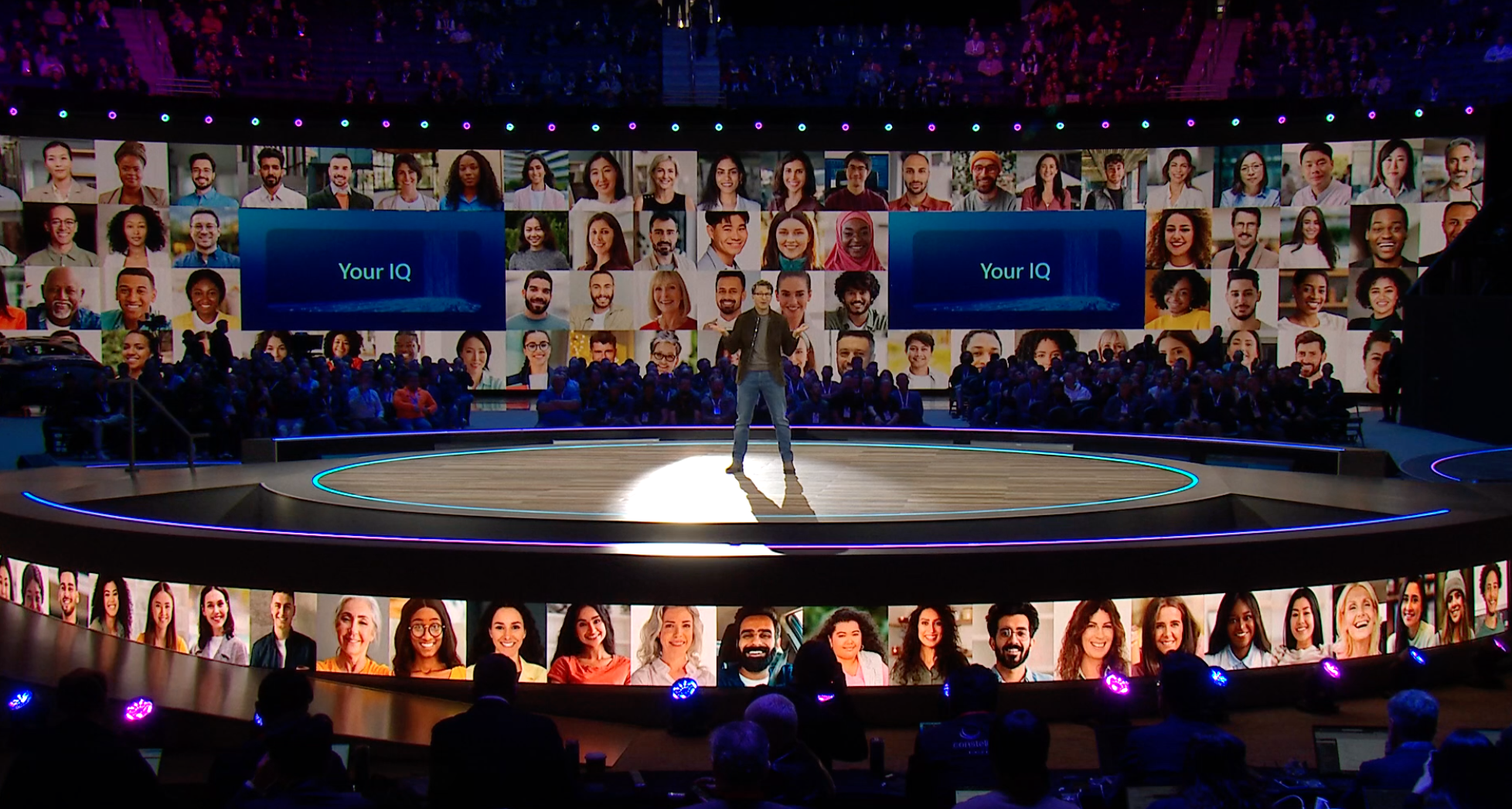

This year’s Microsoft Ignite, the largest annual Microsoft user conference, began with an extensive keynote that lasted over two hours. The keynote was hosted by Judson Althoff, CEO of Commercial Business at Microsoft, who was joined on stage by a variety of Microsoft talent.
Althoff mentioned that during Ignite 2025, over 70 announcements were expected. In the opening keynote, the audience — more than 20,000 in the San Francisco auditorium and 200,000 tuning in via video link — would learn about the most significant updates.
In this roundup, we will focus on the core announcements that introduced Microsoft’s new “intelligence layer.” This series of developments collectively accelerates AI innovation and supports businesses in their goal to become Frontier Firms.
Work IQ
Ryan Roslansky, the CEO of LinkedIn, initially seemed like an unusual choice to present the future of Microsoft’s AI strategy — he even acknowledged this at the beginning of his presentation. However, since LinkedIn is a Microsoft company, Roslansky is a Microsoft Executive Vice President, and the upcoming announcement could well transform the way we work, it quickly became clear that he was the perfect person to deliver it.
Microsoft is rolling out a new, multi-level intelligence layer spearheaded by Work IQ, a new capability that will deliver unique company, job-specific, and user data to inform Microsoft 365 Copilot and agents. Work IQ, a three-part intelligence layer, consists of data (email, chats, files, etc.), memory (like work habits and workflows), and inference.
This framework enables Copilot to access data, retain memory, and understand how tasks and tools interact. Inference helps predict the most suitable action or agent for each job. Work IQ is integrated into Microsoft 365 apps, such as Word and Excel, allowing Copilot to continuously learn through what Microsoft describes as an “AI-powered feedback loop.” This loop far surpasses traditional connectors by retaining context.
Ultimately, this combined, continually updated knowledge bank, which understands in context your specific business, will help create the most tailored, company-specific outcomes from M365 Copilot and agents. However, Work IQ is just one of the competent of Microsoft’s sprawling intelligence layer.
Fabric IQ and Foundry IQ
Later in the keynote, Asha Sharma, President of CoreAI Product at Microsoft, took the stage to reveal the additional components of Microsoft’s multi-faceted intelligence layer: Fabric IQ and Foundry IQ.
Fabric IQ enables humans and agents to understand and interact with data, providing insights and incorporating business logic. This new capability allows agents and users to leverage data organized around concepts unique to a company, unifying data with analytics.
Fabric IQ utilizes semantic understanding, meaning it can link raw data to real-time business logic. With this understanding, both agents and human operators can grasp what the data represents, rather than just seeing it in its raw form. This clarity helps eliminate confusion and speeds up the time to value in development.
Among the announcements regarding Microsoft Foundry was the news that Anthropic’s Claude model family would now be available for users. Additionally, the launch of Foundry IQ was introduced, which represents the final level in Microsoft’s newly launched intelligence layer. Foundry IQ is powered by Azure AI Search and simplifies the process of connecting AI agents with data sources.
This solution removes the traditional processes of customized Retrieval-Augmented Generation (RAG) and offers developers reusable Foundry IQ knowledge bases that can be accessed through a single API. It also provides automated access to indexed and federated knowledge sources, a smart retrieval engine within the knowledge bases, and built-in enterprise-grade security and governance. As a result, agents gain a better understanding of the specific data they need, making them more responsive, easier to deploy, and capable of operating with greater precision.
“Foundry IQ is a culmination of the intelligence of Microsoft Cloud, your custom applications, and the web,” said Pablo Castro, Corporate Vice President and Distinguished Engineer at Microsoft in a blog post. “This announcement is part of Microsoft Cloud-wide initiative to power every organization with universal enterprise context.
“Work IQ from Microsoft 365 provides signals on how your organization operates, Fabric IQ brings business meaning to the data in Power BI, and Foundry IQ unifies and centralizes access to knowledge to ground every agent with the right context.”
Closing Thoughts
Althoff outlined Microsoft’s direction for AI innovation, as: human ambition + Copilot +AI agents. Together, these focus areas aim to democratize intelligence and “move humanity forward” in a business context and regarding broader human innovation. The efforts Microsoft has invested in developing this three-pronged intelligence layer — Work IQ, Fabric IQ, and Foundry IQ — align well with this vision.
Reducing complexity, enhancing specification, and creating unique experiences with Copilot and agents based on foundational company data are essential to ensuring AI works effectively for humans. When AI understands the context, is supported by governance and security, and can access specific data that is built in rather than bolted on, the opportunities for innovation and the chance to become a true Frontier Firm increase exponentially.
Book a Demo

Kieron Allen
Analyst
Cloud Wars, Agent and Copilot

Related Posts